
1913
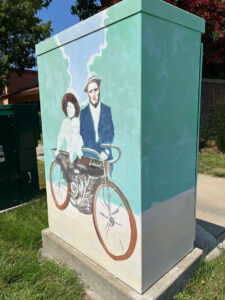 Simple in design, the utility box at the corner of Bernal Ave and Koll Center Parkway stands weathered. Artist Tony Bailey’s apparition of ‘1913’ is a snapshot of a bygone time fading in the public mind. The front of the utility box faces due West. The unhindered sun has baked the image to a ghostly hue. The remaining three sides portray indiscriminate land and a fading blue sky.
Ranchers and thoroughbred horse breeders were attracted to Pleasanton’s favorable climate and abundance of water and were soon followed by dairy farms, hop fields, and vineyards. Blessed with rich soil, Pleasanton soon became the agricultural center for the Amador Valley and home to the oldest horseracing track in the nation. The hops grown here were sought by many of the largest beer producers in the United States and Europe, making Pleasanton internationally famous.
Pleasanton was incorporated in 1894 and by 1900 was a thriving community. Main Street became a center for business and community activity and, although agriculture didn’t completely disappear, Pleasanton was on the road to becoming a modern community. Prosperity was coming to Pleasanton and the artist Tony Bailey portrayed a rustic picture of a well-dressed father and mother standing behind a child mounted on a bicycle. It appears a traveling trunk is also in view, maybe for a picnic. It perhaps portrays the last of the versatile bicycle because, by Dec. 1, 1913, Ford Motor Company instituted the first moving assembly line for the Model T Ford. By April 1917, the U.S. was in World War I.
The Civics Arts Commission under Project Paint Box commissioned “1913” under the Public Art Acquisition Fund in 2016.
Jan Coleman-Knight