
The Tulancingo/Pleasanton Mural
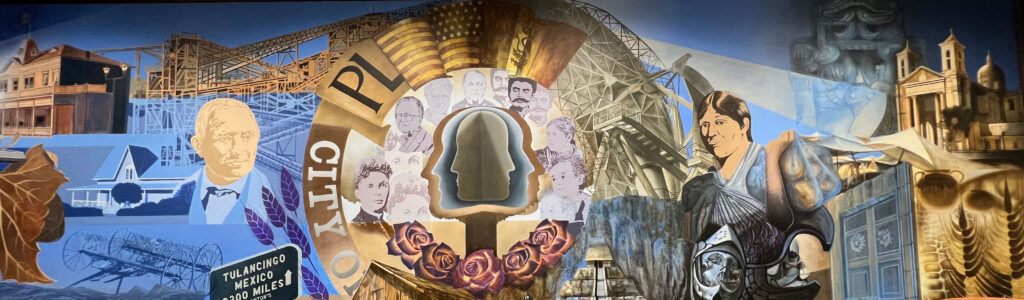 Following the tradition of great Mexican murals, a stunning 1985 artwork on the back wall of the Pleasanton City Council Chambers at 200 Old Bernal Ave., captures the vibrant history of sister cities, Tulancingo and Pleasanton. Designed by 26-year-old Mexican architect and artist Augustin Vargas and executed by a team of artists, the Tulancingo/Pleasanton Mural is an enduring testament to the close friendship of two cities bound by cultural roots and a belief in progress. Tulancingo, Mexico is 2,300 miles southeast of Pleasanton.
At the center of the mural, a solid oak tree trunk brings forth dimensional mirror faces looking to the two sides of the mural. From this single root of commonality, we are encouraged to celebrate the ordinary and extraordinary of both cultures.
On the far right side of the mural, the story of Tulancingo unfolds.
- John the Baptist Cathedral (Catedral de San Juan Bautista) is located in the main plaza of La Floresta in Tulancingo. Built in 1528, it is a focal point of the city and an example of elegant simplicity in Spanish colonial architecture
- Everyday pottery vessels float above rising corn and speak to the importance of maize (corn)in the daily diet. Mixed with wheat, it is a fusion of both Spanish and indigenous cultures.
- A cloth tent stretches over an ordinary blue door and leads to a typical open-air market or “tianguis”. The door is a clear example of Spanish architecture.
- A Blue Face, next to the Cathedral, is a reminder of the belief in gods before the Spanish conquest. Coatlicue is the “mother of gods”. She gave birth to the moon and the stars -Huitzilopochtli (the god of sun and war), and other gods/goddesses. She embodies both creation and destruction.
- An Indigenous woman carries a hidden infant in a traditional woven shawl. She has come down from the mountains on “market day” (Jueves)to sell fruit. Wrapped in tradition and resilience, she reflects the economic role of women and the interweaving of family, labor and culture.
- A C-shaped elite eagle Aztec helmet is below the woman. Eagle warriors were known for their bravery and skill with the eagle representing elite status and military honor.
- A Spanish helmet of a desiccated warrior is below and to the left. The Spanish conquest of Mexico brought war, disease and cultural disruption to indigenous communities. The face represents death and suffering
- The visual trilogy of the indigenous woman, the eagle warrior, and the Spanish helmet reminds us of the three cultures that impacted Tulancingo’s history- Indigenous, Aztec, and Spanish.
- Tezontle Hill offers panoramic views of Tulancingo. A small Christian church, (Iglesia de los Angeles) at the base of the volcanic hill, contains an image of the Virgin Mary painted on an adobe wall. In 1862, Pope Pius IX declared the Virgin of the Angels as the Principal Patroness of the Diocese of Tulancingo. Since then, the image has been highly venerated.
- A pre-Hispanic volcanic step pyramid of Huapalcalco frames a complex spiritual foundation connecting Tulancingo with the ancient past as early as 600-100 BCE. It is oriented according to celestial and ritual alignments, typical of Mesoamerican architecture.
- Cero Del Tecolote is the cliff behind the pyramid, where 1,00 year old red cave paintings in red ochre depict humans, animals, and daily life.
- The arched metal architecture of the Tulancingo satellite station, built in 1968, was a milestone in Mexico’s telecommunications infrastructure. The station broadcast live and in color the 1968 Summer Olympics in Mexico City, FIFA World Cups (1970, 1985), and the fall of the Berlin Wall in 1989. Today, it has transformed from a center for international communications to a new focus, possibly including a museum and research center.
On the far left side of the mural, the story of Pleasanton is revealed
- Computer: Pleasanton’s location near the Livermore National Laboratory brought scientists, engineers, and computer experts to the Tri-Valley. The development of the Hacienda Business Park (1982) attracted tech-friendly commerce. Pleasanton’s proximity to Silicon Valley and expanded highways encouraged the development of tech offices, the biotech industry, and innovation. In 1985, Pleasanton foresaw the future of technology.
- Pleasanton Hotel: In 1898, the Farmer’s Hotel was rebuilt after a fire; it was renamed in 1930 as the Pleasanton Hotel. A notable landmark, the hotel features a stained glass window , “P-Town Race”, which honors Pleasanton’s historic role in horse racing. The hotel has transitioned to office space and a restaurant and no longer operates as a hotel.
- Eliot Quarry Structure – Since the late 1800s, this active mining facility along Stanley Boulevard has been a major supplier of construction aggregates (sand and gravel). Gravel operations were conducted by the Henry J. Kaiser Company, and in 1967, the Company donated 266 acres of former mining pits to the East Bay Regional Park District to create the 1971 Shadow Cliffs recreation area.
- Century House (2401 Santa Rita Road)-Built circa 1878 by George Atkinson as a duck hunting lodge, the Century House was acquired by the City of Pleasanton in 1979. It is a Victorian Gothic Revival structure with historical value and projected contemporary use.
- John W. Kottinger (1819–1892)was an Austrian immigrant who settled in the Alisal area after marrying Maria Refugia Bernal. Her dowry included parcels from Rancho El Valle de San Jose. Kottinger worked as a teacher, court interpreter, and later a lawyer (from 1851), managing legal affairs for the Bernal family. He laid out the part of the town plan in 1867: the blocks south of Division and east of Main were laid out by Joshua Neal, whose wife was Angela Bernal Neal (Agustin’s daughter).
- Sycamore Leaf– The abundance of Sycamore trees along the banks of local arroyos led to the use of the Spanish name “Alisal,” meaning “The Sycamores.” In 1864, John W. Kottinger proposed the name “Pleasonton”, after a Civil War Union general but used “Pleasanton” in a birth announcement signed by him. On June 18, 1894, the Alisal area officially became the town of Pleasanton.
- Hay Farming– Fertile soil and a favorable climate made Pleasanton a highly productive agricultural region. Hay and barley, both essential feeds for horses and livestock, became major crops. Farmers worked vast fields using various types of horse-drawn equipment, including harvesters and rakes, to cut, gather, and transport the crops.
- Hopsbecame a major crop in Pleasanton starting in 1893. By 1913, approximately 2.5 tons of female hops cones were shipped annually, both nationwide and internationally, to support beer and ale production. However, hops are water-intensive. The decline of the Pleasanton hops industry is directly linked to the growth of San Francisco, whose water company owned rights all the way up Alameda Creek and tapped Valley aquifers from about the 1890s at least into the 1920s.
- Rolling hills, vast open lands, and the meandering Arroyo de la Laguna shaped the landscape of the Pleasanton and Livermore valleys. For over 5,000 years, the ancestors of the Ohlone peoples lived here, sustained by a diverse diet, skilled hunting and fishing, and a deep respect for the land. The arrival of Spanish colonizers, Mexican settlers, and 1849 gold seekers led to the displacement and marginalization of Native communities. Today, the Ohlone continue to seek federal recognition and remind us: “We are still here.”
- Kottinger Barn was constructed in 1852 by John W. Kottinger. It is a rare example of Adobe architecture and is on the National Historic Registry. Kottinger was the area’s first Justice of the Peace and it was said, he used his house as the court, and part of the barn as its first jail. Local folklore claims the bandit Joaquín Murrieta was a ‘guest’, but historical evidence is very thin.
At the center, five red roses frame images. The roses are part of the storied past. The Roses represent the Jackson-Perkins red rose, Don Juan, when Pleasanton was once called the “Rose Capital of the World”. Fragrant rose fields blossomed from 1946-1964. It is the city’s flower and celebrated at the annual “Rose Show”.
- Adorable children and a woman rise above red roses—symbols of past and future generations. In Mexican and Indigenous traditions, women have long been central, the moral heart of communities. Under the visionary leadership of Emiliano Zapata, whose ideals of dignity and justice stirred revolutionary change, the foundation was laid for broader social reforms. One such milestone came in 1953, when Mexican women won the right to vote—a victory born of resilience, heritage, and the enduring strength.
- Emiliano Zapata (1879–1919) championed agrarian reform and sought to empower peasants through land ownership. His bold visage, flanked by repeated images, echoes his enduring rallying cry:‘Tierra y Libertad’—Land and Liberty. Zapata organized Indigenous people and peasants into an armed movement demanding justice and dignity. His vision directly influenced Article 27 of the 1917 Mexican Constitution, which allowed for land redistribution. Over time, Zapata became an enduring symbol of resistance, grassroots democracy, and the fight for social equity.
- The Flag of Mexico atop the mural displays the main symbol of the Mexican coat of arms—an eagle perched on a cactus with a snake in its beak and talon. In official versions of the coat of arms, this is often accompanied by a wreath of oak and laurel branches.
Arising out of the Red Don Juan cluster of five roses, is a repeated image of a woman.
- Miss Lillie Harris (1866-1959) was a beloved Pleasanton teacher and active member of the Presbyterian Church in Pleasanton and Oakland. She is pictured with repeated images because her devotion to teaching amplified her effect on future generations. Her brother was Judge T. W. Harris.
- Bespeckled John C. “Jack” Kolln (1919–1994)was a business owner (Kolln Hardware), the first president of the Pleasanton Chamber of Commerce (1946) and a pianist. A dedicated community leader, he helped guide Pleasanton’s transition from an agricultural city to a more diversified economy. The original Kolln Hardware building at 600 Main Street, noted for its Queen Anne and Italianate architecture, still stands today under different ownership.
- Lillie Mae Schneider Fiorio (1896–1990)was born in Pleasanton to German and Irish immigrants. Her father, Jacob, was a blacksmith, and the family raised cows. Lillie delivered milk around town and was known for her lively spirit. After marrying Charles Fiorio in 1919, she worked at Fiorio’s Market on 272 Rose Avenue. Her devotion to community left a lasting legacy.
- Agustin (Agostin) Bernal (1797-1872) served in the Spanish and Mexican military. In 1839, the Mexican governor, Juan Alvarado, granted Rancho El Valle de San José(48,436 acres) to four prominent families, including Agustin and his brother, Juan Pablo. Agustin’s father, Don Refugio Bernal built a racetrack on a portion of the land grant in 1859, making it the oldest one-mile racetrack in America, older than the famed Saratoga racetrack by six years. Pleasanton’s horseracing tradition grew in fame. The California-bred thoroughbred Morvich trained at the Pleasanton track and won the 1922 Kentucky Derby. The famed Depression era Seabiscuit also trained at the Pleasanton track, further extending the historical legacy of horse racing in Pleasanton. The Bernal family’s cattle ranching, horse racing, and farming shaped the valley’s early economy.
- The American flag flutters in a silent breeze with the stars on the right side and the stripes furled to the left. In military action, this symbolizes forward advancement and not retreat. The stars are the 50 states of the United States; the blue is vigilance and justice. The Red stripes are valor and bravery; the white stripes are purity and innocence. There are 13 stripes, 7 red and 6 white.
The citizens of Tulancingo, Mexico, presented this mural as a sister-city gift to Pleasanton on October 24, 1985. Mayor Ken Mercer and Augustin Vargas dedicated it with the idea that the painting team would reassemble in the future to finish the mural. As of 2025, it remains incomplete.
The following article was completed circa 1985 by an unknown writer. Both Augustin Vargas and Margene Gerton Rivara (Margene Helling) have reviewed it for accuracy.
Technical Aspects of the Mural
“The mural is painted upon a substrate of compressed particle board which has been treated with three coats of gesso.
The elements were traced using the Greek mathematical theory of the Golden Mean or Golden Section. This method was first used by the Greeks, then again from the Renaissance through modern times. This formula permits a multi-faceted work to retain harmonious proportions and remain balanced. The square root of five was used as the mathematical base of the harmonic rectangle in this mural.
The figures were sketched with carbon pencil and blocked with a thin solution of acrylic paint. The artists used primarily acrylic paint and water with a variety of brush types. Flat color and restricted range of color were used, mixing two or three shades of color to create a very synthetic color spectrum. A traditional method of tinting was also used to create effects of transparency and illumination. This was done by applying the most brilliant or intense color first and then layering darker colors over it.
The special effects of lights and shadows were created with an airbrush. Modeling paste was used to provide the texture to various elements of the mural.
The Artists
Augustin Vargas Velasco is an architect and artist living in Tulancingo. He graduated from the National University of Mexico in architecture and studied art at the Academy of San Carlos, the most prestigious art school in Mexico. Mr. Vargas studied with Arnold Belkin, a Canadian muralist; Leo Acosta; Antonio Ramirez; Jost e Santiago; Guati Rojo; and Valdy. Mr. Vargas was 26 years old when he designed and executed the mural under the auspices of the Tulancingo Sister City Committee.
Ron Normas, assistant to Mr. Vargas, is a landscape artist and resident of Pleasanton.
Members of the mural team were: Bill Hamilton, Horatio Jaramillo, Maria Elena de Luna, and Margene Helling (Margene Gerton Rivara).”
Jan Coleman-Knight