
Pleasanton Centennial – Part 1 – The Mural
The alchemy of sun and color animates gleaming ceramic tiles, bringing to life the stories of Pleasanton’s past. Three towering, multi-sided 10-foot stelae rise like luminous guardians in Civic Park, 100 Main Street, their mosaics tracing the journey from Ohlone homelands to the jubilant 1994 Pleasanton centennial celebration.
Artist Guillermo Wagner Granizo designed the kiln-fired tiles as an Art Producer storyboards a film, drawing directly on the clay without pre-sketching, then firing each piece in his Benicia studio. He chose saturated crimson reds, sunflower yellows, and cobalt blues, often contrasting warm colors against cool to achieve a childlike immediacy. His proprietary glazes, created from minerals, oxides, and pigments, were both a technical innovation and his artistic signature, their luminous, cinematic color chosen not only for beauty but to evoke emotion and tell Pleasanton’s story.
Granizo organizes his cinematic mosaic in colorful visual layers. Each panel has a blue sky filled with birds; a middle layer populated with people and events; and a bottom earth layer of flowers anchoring the heart of civic memory. Human activities may change, but the continuity of sky and earth creates a horizontal line of continuity. Viewed from four different vantage points in the Civic Park, the stelae align perfectly to create three-panel murals, each portraying a different aspect of Pleasanton’s history: culture, agriculture, railroad, and commerce.
Cultural History
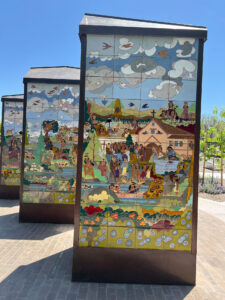 Standing on the sidewalk with your back to Main Street, a panorama of symbols speaks of the 4,000-year cultural legacy of the Ohlone homeland.
The three panels tell the story.
- Drawn from Ohlone creation stories, when the world was covered with water, Coyote and Eagle sat atop Mt. Diablo and cast down a feather that grew into the first dry land, from which rivers, valleys, and life itself emerged. (Also see the Pleasanton public art Diseno). A Franciscan Friar and horseback men with a cross foretell tension between indigenous beliefs and the imposition of conversion to Christianity.
- In the next panel, Coyote becomes a teacher, guiding the first people in the skills of survival—how to hunt and fish, and how to gather and prepare acorns, the staple of Ohlone life. The Ohlone Peoples were wise stewards of the land, harvesting acorns from Oak trees and burning grass to manage the land and generate more seeds. A raised arm protests an unwelcome horseman, and a bearded rifleman disrupts the peaceful accord.
- Mission life is depicted in the third panel with an imposing church, tortilla making and an unfortunate change to western clothes. A tule boat navigates the original lagoon that was part of West Pleasanton, running parallel to Pleasanton Ridge. In the distance, huddled Mission escapees represent the Ohlone. Bay Miwok also were hiding out with head bounties on all indigenous people. This panel reflects a period of profound transition; these images portray a time when cultural survival was challenged by assimilation, yet traditions continued in adapted forms.
Agriculture
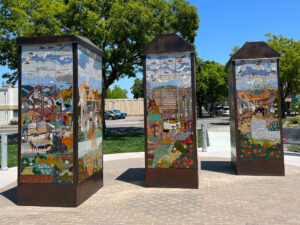 Moving counterclockwise, the next mural shows Pleasanton’s agricultural history.
- A large Ferris Wheel announces Alameda County Fair attractions, including 4-H groups, and the nation’s oldest one-mile racetrack, all celebrated by enthusiastic donors. Behind the Ferris Wheel, look for the human cannonball; entertainment and agricultural shows were intertwined amusements. Watch a harness-racing sulky pass a picket fence, reminding us that horse racing was tied to its grain industry, especially alfalfa. A wide range of townspeople were employed in the horse racing business. Casual Lies, a thoroughbred colt trained in Pleasanton by Shelly Riley, placed second in the 1994 Kentucky Derby.
- The middle panel displays farming ventures of the 19th and early 20th centuries, including water-intensive hops grown on 20-foot poles, dried in large kilns, and exported to England and Ireland for brewing. Cattle ranching provided meat for sale and tallow for export to Spain, where it was used in candles, soap, and lard. The Jackson & Perkins rose growers relocated from the East Coast, finding Pleasanton’s soil and climate ideal; their red “Don Juan” rose became the City’s flower.
- This panel highlights the diverse groups who made their home in the Amador–Livermore Valley: Indigenous Peoples (Ohlone, Miwok and other Mission San Jose escapees), Spaniards, Anglos, French, Australians, Samoans, Hawaiians, and Portuguese, whose cultures all contributed to shaping the land. Notice the train car. It signals the export of crops, while a worker with a rake over his shoulder embodies the labor that sustained Valley agriculture.
Railroad
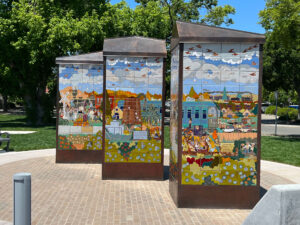 Continuing counterclockwise, the next three panels show how the railroad shaped Pleasanton’s growth.
- A belching black locomotive pulls a red car of awestruck visitors as a movie scene unfolds. Before the railroad, Pleasanton’s hops, grain, wine grapes, dairy, and later fruits could only reach markets by wagon and horse team — slow and costly. The Central Pacific Railroad arrived in 1869 (later part of Southern Pacific), with a station near today’s Neal Street and Pleasanton Avenue. In 1909, the Western Pacific main line opened a second depot on Rose Avenue, shown here. With two rail lines, Pleasanton had direct shipping to San Francisco, Oakland, Sacramento, and beyond. Rail traffic boosted commerce and even lured the movie industry. In 1914, Essanay Studios in nearby Niles (now Fremont) signed Charlie Chaplin; “Rebecca of Sunnybrook Farm” starring Mary Pickford was filmed on Main Street. She is depicted in black and white from a period photo.
- The middle panel shows the train passing a water tower, a church, and new buildings. A sign reminds viewers: “Alameda County Fair since 1912, oldest racetrack in America since 1858.” Traditions endured even as the town advanced commercially. Granizo’s humor appears again: a railroad crossing sign in the first panel reads “Look out for the Cars” (meaning rail cars) is echoed here by wide-eyed observers. The inscription on this panel ties the railroad to the Alameda County Fairgrounds, where trains once brought crowds to the racetrack and the spectacle of the fair. With his dripping water tower and ambiguous figures, Granizo adds a wink of humor, reminding us that history is lively, messy, and full of character. Notice the birds fly is a strange pattern.
- In the final panel, a distant train and a near caboose emphasize Pleasanton’s two rail systems moving in opposite directions. A horse carriage competes with cars. This scene brims with Granizo’s playful spirit — birds dart in every direction, cars weave at odd angles, a single railroad worker pumps a handcar to check the tracks, a task that requires two, and pedestrians strike animated poses. Instead of a tidy scene of progress, he gives us a lively tangle of motion, gently poking fun at the bustle and contradictions of modern life around the railroad. Passenger service stopped in the early 1960s as highways and automobiles took over, though freight trains continued. Rail passengers returned with ACE train in 1998 and BART’s Dublin/Pleasanton extension in 1997, bringing trains back to Pleasanton.
Commerce
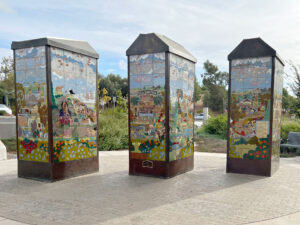 The last panels bring Pleasanton forward to its 100-year-old anniversary by celebrating its commercial history.
- Pictured in the upper-right corner is the Sunol water temple. The Hacienda Business Park arches seem to capture a flying bluebird. By the early 1990s, several office buildings were completed on the 875-acre parcel situated at the I-580 and I-680 intersection, and major companies began moving in. Today, Hacienda Business Park is one of the largest mixed-use business parks in the Tri-Valley, hosting offices, tech firms, and light industrial operations. Sailing boats on the lake at Shadow Cliffs recreational area catch a breeze. The rotunda at the Stoneridge Mall offers shopping. The Pleasanton Hotel has a watchful eye on the Arroyo del Valle, which runs through the heart of downtown until it was diverted for urban growth. Pleasanton blends historic landmarks, recreation, and modern business into a vibrant community.
- The famous Pleasanton sign over Main Street dominates the center panel, framed by parading figures. Donated to the city in 1932 by the Pleasanton Women’s Club, the iconic sign anchors a scene alive with a jumble of activity. Figures, birds, and architectural elements overlap and intersect, creating a dynamic, bustling composition that evokes the energy of a parade or civic gathering. Granizo captures a playful sense of community celebration.
- The Hacienda Business Park arch ties the three panels into a summary. Above the white archway is the Phoebe Appearson Hearst estate, The Hacienda del Pozo de Verona. Designed by the famed architect Julia Morgan, the original building was destroyed by fire in 1969. Only the Music Room was saved intact. A 1970 reconstruction on the site echoed the original design. Today, it is part of the Castlewood Country Club. Below the archway is Amador Valley High School. Built in 1922, the facade reflects early Spanish influence. Julia Morgan’s design of the 1932 Veterans Memorial Building in Pleasanton also displays this influence.
- Granizo enlivens this final scene with animated, almost theatrical figures whose exaggerated gestures, along with birds and objects, intersect in unexpected ways, revealing his characteristic sense of humor.”
Artist Guillermo Wagner Granizo includes a final note to the viewer with a chronicle of his struggles with cancer, loss of an eye and his personal year-long hardships to complete the installation of the 1994 commissioned mosaic mural. His indomitable spirit is seared into every tile, every panel, creating a cinematic sequence of Pleasanton stories. He died on November 9, 1995, in Benicia, California, ten days after the dedication of the mural.
Pleasanton Centennial – Part 2 – About the Artist, Guillermo Wagner Granizo
Guillermo Wagner Granizo was born William Joseph Wagner on March 11, 1923, in San Francisco. He adopted the name Guillermo Wagner Granizo in 1970, reflecting his mother’s Nicaraguan heritage. Guillermo is Spanish for Bill; Granizo was her maiden name. Many knew him as “Bill” when he was the Art Director for KRON-TV in San Francisco until 1960. At age 50, he turned his attention and energy to creating ceramic tile murals, carrying forward his background in art production and storyboarding. Drawing scenes directly on tiles-he drew in layers and sequences, almost like scenes in a movie.
Guillermo Wagner Granizo was a pioneering tile muralist whose bold, layered mosaics brought history, community, and imagination to life on public walls across California and beyond. “Bill” Granizo’s murals adorn numerous public buildings, hospitals, museums, and aquariums. He created several tile murals for the Steinhart Aquarium in San Francisco, which is now part of the California Academy of Sciences. His involvement with the aquarium spanned over three decades, beginning in the 1950s and continuing into the 1980s.
The Monterey Mural at the Monterey Conference Center was completed in 1984. This 11-foot by 45-foot ceramic tile mural illustrates the history of Monterey, from the native Rumsien people to the 1980s.
Granizo’s Olympic Fantasy mural, spanning 93 feet wide by 24 feet tall, bursts with color and movement, celebrating every sport of the 1984 Los Angeles Olympics. This monumental tile masterpiece captures the energy, ambition, and spirit of the Games. It is on the west side of the PE building on the Cal-State LA campus, the location of the Judo and Wrestling events.
The Benicia First Street Tiles are 28 very large tile murals embedded in the concrete sidewalk, capturing the city’s history through vibrant pictorials. Visit www.beneciahistory.org to view his dedication to preserving local heritage through mosaic art and enjoy a self-guided tour.
While enduring chemotherapy, blood transfusions, and the loss of an eye, the Granizo persevered to complete his final artwork, the Pleasanton Centennial mural, a testament to his passionate embrace of art and storytelling. He died November 9, 1995, 10 days after the dedication of the mural. He is survived by two sons, two grandchildren, five great-grandchildren, all living in the San Francisco Bay Area.
A more extensive biography of the artist is attached to public artwork Self-Portrait Guillermo Wagner Granizo and www.granizoart.com His life is marked with severe injury, near death, reclaimed purpose and the glory of colorful ceramic tiles until his last breath.
Jan Coleman-Knight